

Build Voice Agents From Scratch (Course + Research starter kit)


Original price was: $ 999.00.$ 35.00Current price is: $ 35.00.
A video-based engineering course on building real-time voice AI agents, from speech-to-text, language-model and text-to-speech pipelines to function calling, testing and deployment, plus a Research Starter Kit.
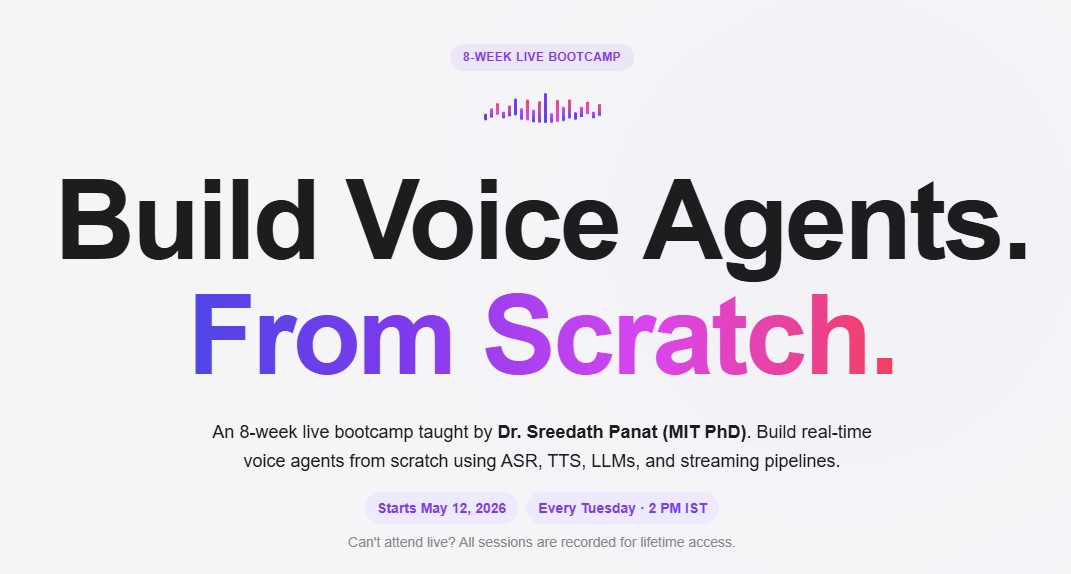
Build Voice Agents From Scratch is a video-based engineering course for developers, technical founders and automation practitioners who want to assemble real-time voice systems themselves instead of relying only on templates. It pairs step-by-step video tutorials, practical projects and implementation examples with a Research Starter Kit of curated resources, implementation guides and reference material on advanced techniques and emerging technologies.
What you’ll learn
- Understand voice AI architecture and real-time pipelines, and how each stage adds to the delay a caller hears.
- Integrate speech-to-text, large language models and text-to-speech into one working pipeline.
- Design conversational workflows and dialogue management so the agent knows when a speaker has finished and what to do next.
- Build voice agents with function calling and automation that connect to external APIs.
- Optimize latency for natural conversations through performance tuning.
- Test, debug and deploy voice AI applications.
How a voice agent pipeline fits together
A typical voice agent is a chain of stages. Speech-to-text turns incoming audio into a transcript, an orchestration layer decides when the user has stopped talking, a language model writes the reply or calls a tool, and text-to-speech turns that reply back into audio. The total response time is the sum of every stage, which is why the course treats latency as a pipeline problem rather than a question of picking one fast model.
Streaming and interruptions
Streaming lets the stages overlap: recognition emits partial words, the model can start from a stable partial transcript, and synthesis can begin speaking before the full reply is written. A natural agent also has to stop talking when the caller interrupts, without being cut off by every background noise.
Function calling and automation
Function calling lets the agent take actions during a call, such as looking up a record or booking a slot through an external API. The course names customer support, scheduling, sales and business automation as example applications.
Testing, debugging and deployment
The later material moves from a working prototype to a deployed application, covering testing, debugging and deployment of voice AI systems alongside performance optimization.
The Research Starter Kit
The Research Starter Kit is a collection of curated resources, implementation guides and reference materials for going further into advanced voice AI techniques and emerging technologies after the main lessons.
What’s in the course files
The download is about 3.75 GB and contains the video lessons, project and implementation material, and the Research Starter Kit documents.
Who this course is for
The course suits developers and technical founders who are comfortable writing code and want to own their voice stack. Function calling, API integration and deployment need real programming ability, and the speech, language-model, voice and hosting services you connect to are third-party APIs with their own subscriptions and usage costs. The instructor is not named.
Be the first to review “Build Voice Agents From Scratch (Course + Research starter kit)”
Related products

Artificial Intelligence

Artificial Intelligence

Artificial Intelligence

Artificial Intelligence

Artificial Intelligence

Artificial Intelligence

Artificial Intelligence

Artificial Intelligence

Reviews
There are no reviews yet.